Licensed and insured concrete and masonry contractors serving Central Florida. Quality work, honest pricing, no surprises.
Contact Info
What commercial decision-makers in Lake County actually need to know before choosing epoxy flooring — from system selection to installation timelines.
Most business owners don’t think about their floors until something goes wrong. A crack that keeps spreading. A surface that’s started to dust and stain. A client walks through the door and the first thing they notice is the floor — and not in a good way. If you’re running a commercial facility in Lake County, you already know that the floor takes more punishment than almost anything else in the building. What you might not know is how much the right flooring decision can change the day-to-day reality of running that facility. Here’s what commercial epoxy flooring actually involves — and how to know if it’s the right move for your space.
Epoxy isn’t paint. That’s the first thing worth understanding. A professional commercial epoxy system is a two-component, chemically cured coating that bonds to concrete at a molecular level — creating a surface that’s seamless, impervious, and significantly harder than the concrete beneath it. It doesn’t sit on top of your floor. It becomes part of it.
For businesses, that distinction matters. A properly installed commercial epoxy floor handles heavy foot traffic, rolling equipment, chemical spills, and daily cleaning without breaking down. It also dramatically reduces the concrete dusting and particulate contamination that affects air quality in warehouses, production facilities, and food service environments. And depending on the system, it can look exceptional — which matters just as much in a Clermont showroom as it does in a Leesburg distribution center.
When contractors talk about industrial epoxy floor coating, they’re usually referring to systems engineered for environments where the floor is under serious stress — forklifts, pallet jacks, chemical exposure, thermal cycling, or all of the above. The specifications that matter most aren’t the ones on the marketing brochure. They’re the ones tied to how the system is built and what it’s built for.
Coating thickness is one of the clearest indicators of system quality. Commercial and industrial epoxy systems range from 10 to 250 mils in thickness. A thin-coat decorative system might be perfectly appropriate for a professional office or retail space. A loading dock or manufacturing floor needs something substantially heavier — typically an epoxy mortar system that can absorb impact and resist abrasion without cracking or delaminating under load.
Chemical resistance is another specification that gets glossed over in residential conversations but becomes critical in commercial ones. If your facility handles oils, solvents, cleaning agents, or food byproducts, the topcoat chemistry needs to be matched to that specific exposure. A system that performs well in a dry warehouse may fail quickly in a commercial kitchen. This is why system selection is a consultation process, not a catalog order.
Compressive strength, slip resistance ratings, and cure schedules round out the technical picture. Most commercial systems allow light foot traffic within 24 hours of application, but full cure — the point at which the floor can handle full operational load — typically takes around 72 hours. For businesses that can’t afford extended downtime, that cure window is a planning variable, not an afterthought. Phased installation, off-hours scheduling, and fast-cure formulations all exist specifically to work around it.
The reason many commercial epoxy floors fail prematurely has nothing to do with the product. It comes down to surface preparation. Diamond grinding or shot blasting to create the right surface profile, moisture vapor emission testing, crack repair, and degreasing — these steps are what determine whether a floor lasts two years or twenty. A contractor who skips or rushes surface prep is handing you a ticking clock, not a floor.
Lake County’s commercial landscape has changed considerably over the past several years. The US-27 corridor through Clermont and Groveland has seen substantial warehouse and distribution development, driven by the county’s position between the Florida Turnpike and Interstate 4. Those facilities need industrial epoxy flooring that holds up under forklift traffic, resists the oil and hydraulic fluid that inevitably ends up on the floor, and can be cleaned efficiently during shift changes.
Leesburg’s growing medical district presents a different set of requirements. Healthcare and laboratory environments need seamless, impervious flooring that eliminates the grout lines and surface irregularities where bacteria accumulate. Quartz broadcast epoxy systems are common in these settings — durable, hygienic, and compliant with Florida DBPR standards for food service and healthcare facilities. Those same standards apply to every commercial kitchen in Mount Dora, Tavares, and throughout Lake County, where seamless flooring isn’t optional — it’s a regulatory requirement.
What makes industrial epoxy flooring in Lake County specifically challenging is the climate. The county’s proximity to over a thousand freshwater lakes keeps ambient humidity consistently high — often above 70 to 80 percent, and higher during summer months. Moisture vapor transmission from concrete slabs is one of the most common causes of coating failure in Florida, and it’s almost never visible before installation. A contractor who doesn’t test for moisture vapor before applying any coating is skipping a step that can invalidate the entire installation within a year.
Temperature also plays a role. The difference between a climate-controlled interior at 70 degrees and a summer exterior at 95 degrees creates thermal cycling in concrete that stresses coatings over time. Flexible topcoat systems are designed to accommodate that movement. For covered loading docks, open-bay service areas, or any semi-exterior commercial application, UV-stable topcoats are also necessary to prevent yellowing and surface degradation from Florida’s sun exposure. These aren’t edge cases — they’re standard considerations for any commercial flooring project in this region.
Want live answers?
Connect with a Stone Forge USA expert for fast, friendly support.
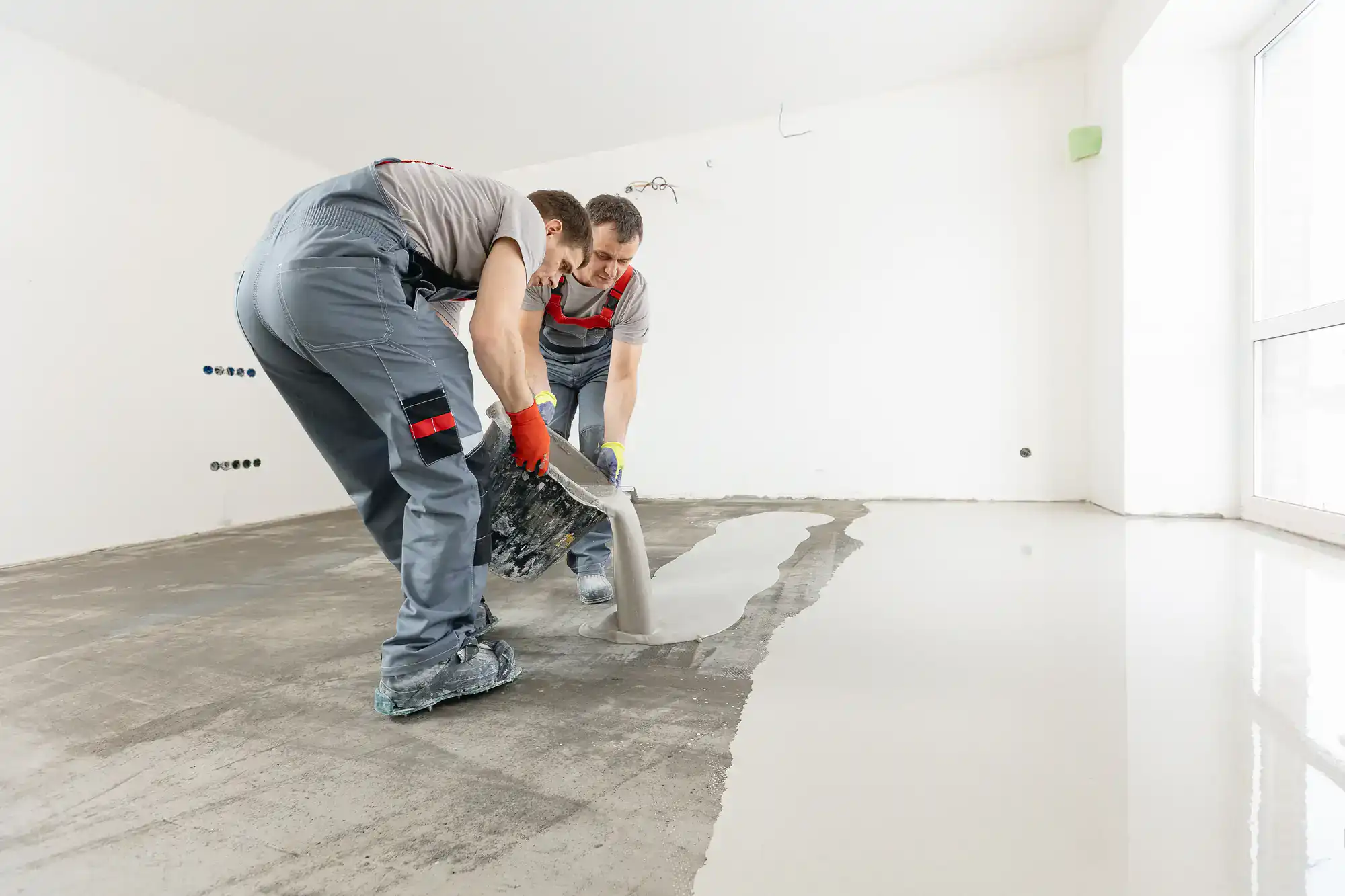
There isn’t one commercial epoxy system. There are several, and they serve different purposes. Self-leveling epoxy creates a smooth, seamless surface well-suited for showrooms, professional offices, and healthcare environments. Epoxy mortar systems are the heaviest-duty option — built for manufacturing floors, loading docks, and anywhere heavy machinery operates. Broadcast flake systems add decorative texture and built-in slip resistance, making them popular in auto dealerships, gyms, and retail environments. Quartz aggregate systems combine durability with a refined appearance and are standard in commercial kitchens and laboratories.
The right system for your facility depends on what the floor actually has to handle — not on what looks good in a photo. That assessment is where the process starts.
The installation process for commercial epoxy flooring systems follows a consistent sequence, and understanding it helps you plan realistically — especially if your facility needs to stay operational during the work.
It starts with a thorough assessment of the existing concrete. Surface profile, moisture vapor emission levels, pH, existing contamination, cracks, and spalls all need to be evaluated before any product is selected or applied. This step isn’t optional. The condition of the substrate determines which system is appropriate, how extensive the prep work needs to be, and what the realistic timeline looks like. Skipping this assessment is how projects end up with scope surprises mid-installation.
Surface preparation follows the assessment. For commercial installations, this typically means diamond grinding or shot blasting to open the concrete surface and create the mechanical profile the epoxy needs to bond properly. Any cracks, spalls, or damaged areas are repaired at this stage. If moisture vapor is present at levels that could compromise adhesion, a moisture-tolerant primer or vapor barrier system is applied before any coating goes down.
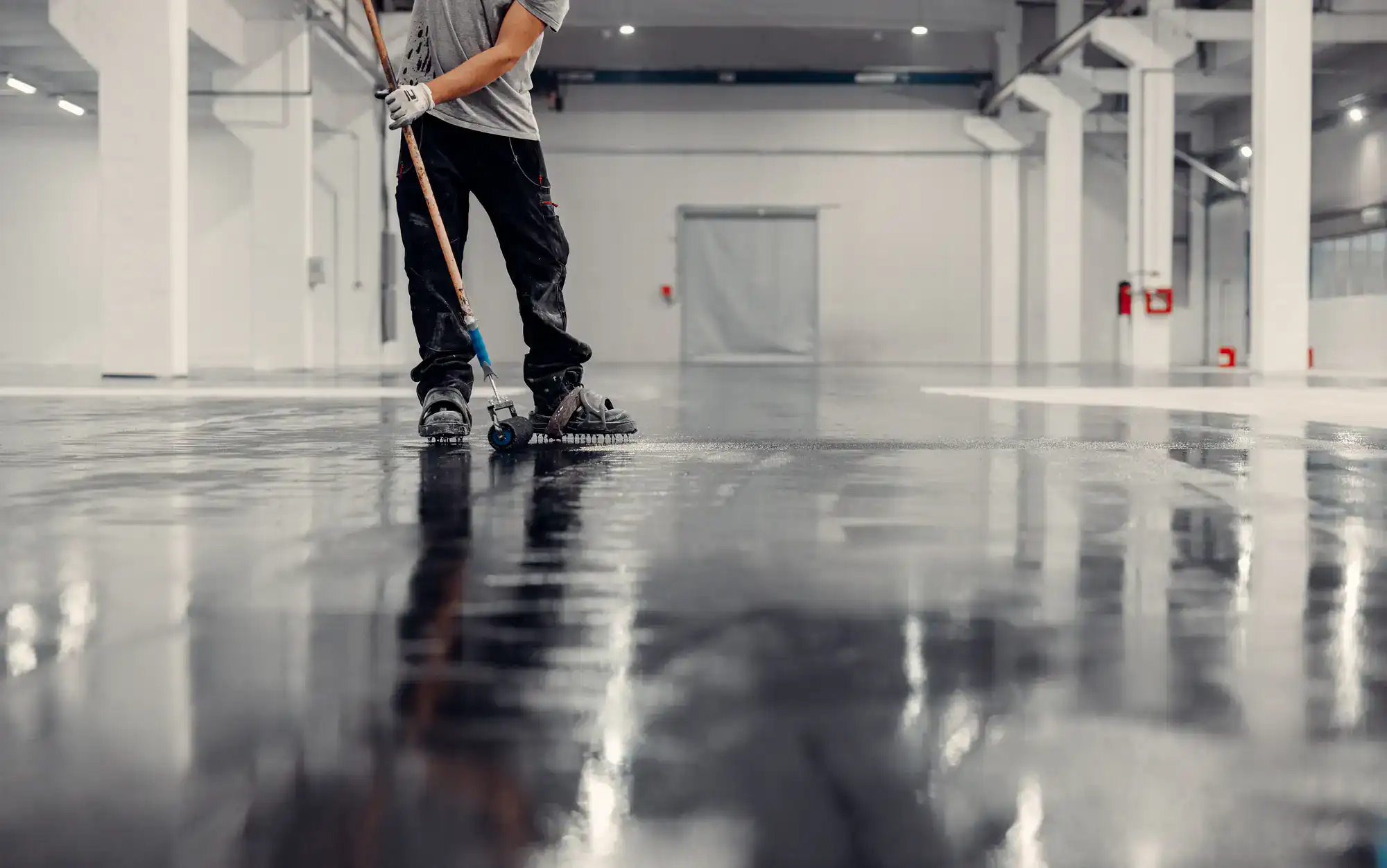
Once prep is complete, we apply the system in layers — primer, base coat, broadcast aggregate if specified, and topcoat. Each layer has a cure window before the next can be applied. The total installation timeline for a commercial project varies based on square footage, system type, and site conditions, but most standard commercial installations can be completed in two to four days. Fast-cure polyaspartic topcoat systems can compress that timeline significantly when business continuity is the priority.
For businesses that can’t shut down entirely, phased installation is a practical solution. We work section by section, allowing portions of the facility to remain operational while adjacent areas cure. Off-hours and weekend scheduling is another option that eliminates daytime disruption entirely. The goal is always to minimize the impact on your operation — not just because it’s convenient, but because we understand that your floor is also your business floor, and every unnecessary hour of downtime has a real cost.
Pricing for commercial epoxy flooring is one of the most opaque parts of the industry, and it creates real problems for buyers trying to make informed decisions. Most contractors give vague estimates over the phone and leave the detailed breakdown for the invoice — which is often when the surprises appear.
Installed cost for commercial epoxy systems typically ranges from three to twelve dollars per square foot, depending on system type, the condition of the existing concrete, and any specialized requirements like anti-static properties, chemical resistance upgrades, or custom color work. Labor generally accounts for one to five dollars per square foot of that total. A straightforward self-leveling system in a clean, well-prepared space sits toward the lower end of that range. A heavy-duty epoxy mortar system in a facility with significant concrete damage and chemical exposure requirements sits toward the higher end.
The reason that range is wide isn’t because pricing is arbitrary — it’s because the scope genuinely varies. A 5,000-square-foot warehouse floor with minor surface cracking and light traffic requirements is a fundamentally different project from a 5,000-square-foot commercial kitchen with moisture issues, regulatory flooring requirements, and equipment that can’t be moved off-site during installation. The square footage is the same. The project is not.
What transparent pricing looks like in practice is an itemized breakdown before any work begins — materials, labor, surface preparation scope, and any additional work required by the substrate condition. No line items that appear after the fact. No vague “additional prep” charges that weren’t discussed. When you know exactly what you’re paying for and why, you can make a real decision — and you can present that decision to ownership or management without hesitation.
We also provide project tracking throughout the installation, so you’re never left wondering where things stand. And after the work is complete, we follow up to make sure the floor is performing the way it should. That follow-up isn’t a formality. It’s how we find out early if anything needs attention — and how we build relationships with clients who come back when the next project comes up.
The contractor you choose matters more than the product they use. Surface preparation, system selection, and installation quality determine whether a commercial epoxy floor lasts a decade or starts failing in a year — and none of those things show up in a quote comparison.
Ask about our prep process. Ask how we handle moisture vapor in Lake County’s climate. Ask for references from commercial projects similar to yours, not just residential garage photos. Ask what happens if something goes wrong after installation. The answers will tell you more than any marketing claim.
If you’re managing a commercial facility in Lake County, FL — whether that’s a warehouse along the US-27 corridor, a medical office in Leesburg, a retail space in Mount Dora, or anything in between — we’re worth a conversation. Reach out directly and we’ll give you a straight answer on what your project actually involves.
—
**Frequently Asked Questions**
**What makes commercial epoxy flooring different from residential?** Commercial systems are built for environments that residential products simply aren’t designed to handle. The coating thickness, chemical resistance, compressive strength, and surface prep requirements are all substantially higher. A residential garage floor coating might be 10 to 15 mils thick. A commercial or industrial system can reach 100 mils or more. The installation process is also more involved — commercial concrete tends to have more contamination history, more surface variation, and more demanding cure requirements.
**How long does industrial epoxy flooring installation take?** Most commercial installations take two to four days from surface prep to final topcoat, depending on the size of the space and the system specified. Fast-cure systems can compress that timeline. For larger facilities or projects requiring phased installation to keep operations running, we build the schedule around your operational needs — not the other way around.
**Can epoxy flooring be installed while my business stays open?** In most cases, yes — with the right planning. Phased installation, off-hours scheduling, and fast-cure topcoat systems all make it possible to maintain some level of operation during the work. We assess your facility layout and operational schedule before the project starts and build an installation plan that minimizes disruption. This is especially important for Lake County businesses operating in competitive markets where any downtime affects revenue.
**Is epoxy flooring slippery when wet?** High-gloss epoxy can be slippery when wet if installed without anti-slip additives. Commercial systems routinely incorporate aluminum oxide, broadcast quartz, or sand aggregate into the topcoat to create a slip-resistant surface. For facilities subject to OSHA General Industry Standard 29 CFR 1910.22 — which covers most warehouses, manufacturing environments, and food service operations in Lake County — we specify anti-slip systems as standard.
**How does Florida’s humidity affect commercial epoxy flooring?** It’s a real factor, and any contractor who doesn’t account for it is taking a shortcut that will cost you. Lake County’s consistently high humidity — amplified by the county’s proximity to over a thousand lakes — means moisture vapor transmission from concrete slabs is a common issue. We test every substrate before coating and use moisture-tolerant formulations where needed. Properly addressed, Lake County’s climate doesn’t prevent excellent epoxy flooring results. Ignored, it’s one of the most common reasons coatings fail within the first year.

Summary:
Share: