7 Garage Flooring Options Beyond Basic Coatings

Most garage floors settle for basic gray. Here's what's actually possible — and why the right system matters more than most people realize.

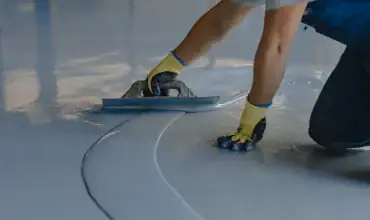
Worker applying epoxy coating to a concrete floor with a squeegee.

Most homeowners in Lake County don’t realize how many garage flooring options exist until they’ve already settled for the most basic one. The standard gray flake floor works fine — but if your garage doubles as a workshop, a home gym, a collector car space, or just a room you actually spend time in, “fine” probably isn’t what you’re after. Lake County’s heat, humidity, and UV intensity mean the wrong system won’t just disappoint you aesthetically — it’ll fail on you. Here’s a look at what’s really available, how each system works, and which situations each one is built for.

Epoxy Terrazzo and Marble Epoxy: Decorative Garage Flooring That Actually Holds Up

When most people hear “terrazzo,” they picture airports and hospital lobbies — those polished, speckled floors that have been around for decades. What they don’t realize is that modern epoxy terrazzo systems bring that same look into residential spaces at a fraction of the traditional cost. In Lake County, where new construction in Clermont and Minneola is booming and homeowners are investing more in their spaces, the demand for design-forward flooring has grown considerably.

Marble epoxy takes things in a different direction. Rather than a speckled aggregate look, marble epoxy uses layered pigments and a hand-applied swirling technique to create a surface that genuinely resembles natural stone. No two floors come out identical, which is part of the appeal. For a garage that doubles as a showroom or a bonus living space, it’s a finish that makes people stop and look twice.

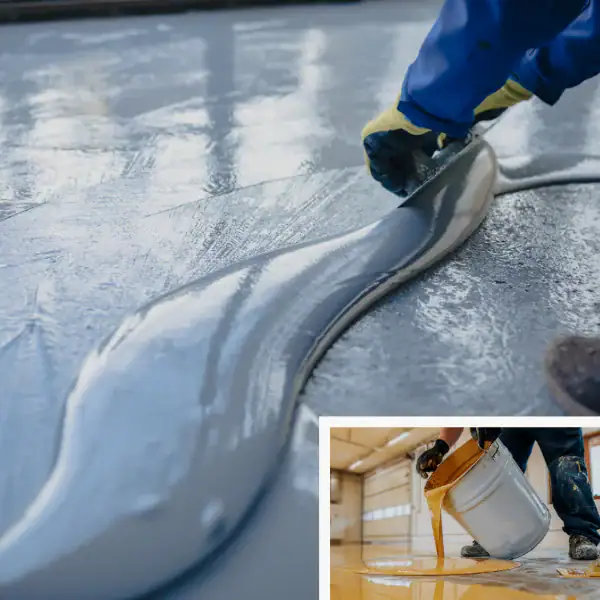
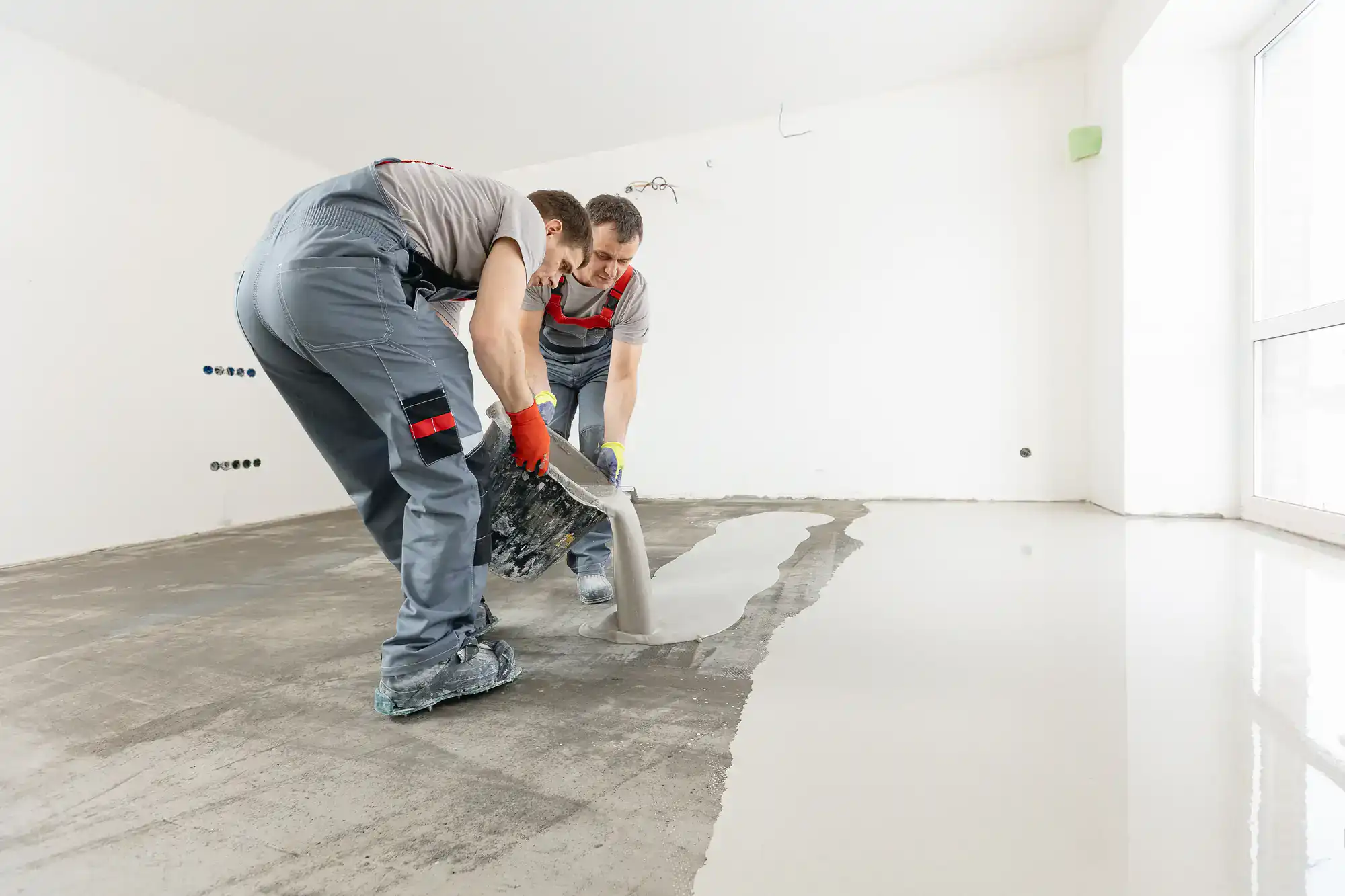
Concrete pouring and smoothing process at a construction site.

How Epoxy Terrazzo Works — and Why It Lasts

Traditional terrazzo involves embedding marble or glass chips into a cement base, then grinding and polishing the surface over multiple days. It’s labor-intensive, which is why it historically landed in commercial and institutional buildings where the budget supported it. Epoxy terrazzo achieves a visually comparable result through a resin-based system that’s applied in layers, seeded with aggregate, and finished with a protective topcoat. The process is faster, more accessible for residential projects, and produces a surface that’s just as durable — if not more so — than its cement-based predecessor.

In Florida’s climate, durability isn’t just a selling point. It’s a requirement. Lake County’s humidity, combined with the intense UV exposure that comes with Central Florida’s sun, creates conditions that expose every weakness in a poorly specified floor. We use UV-stable aliphatic topcoats — rather than the aromatic epoxy formulas that budget contractors often default to — to resist the yellowing and fading that Florida homeowners are unfortunately used to seeing. The color you choose on day one should still be the color you’re looking at in year ten.

The other factor that determines whether an epoxy terrazzo floor lasts is what happens before the coating ever goes down. The concrete surface needs to be mechanically diamond-ground to the correct profile — not just acid-etched or pressure-washed. That grinding creates the texture the resin bonds to. Skip it, or do it wrong, and the floor delaminates. It’s that straightforward. Because we come from a masonry background, substrate preparation isn’t something we treat as a formality. It’s the foundation everything else depends on.

Marble Epoxy Floors: What the Application Process Actually Involves

Marble epoxy isn’t a product you pour and roll out. It’s a technique. The base coat goes down first, followed by carefully applied pigment layers that are manipulated while the resin is still workable — using tools and methods that require skill and precision. The result is a flowing, organic pattern that mimics the veining and depth of natural stone. Done well, it’s genuinely striking. Done poorly, it looks like a craft project gone wrong, which is why the person applying it matters as much as the materials themselves.

For Lake County homeowners who are thinking about this finish for a garage, patio, or basement space, a few things are worth understanding upfront. First, marble epoxy is not a DIY-friendly system. The timing, the layering, and the technique require experience and a steady hand. Second, the topcoat selection matters enormously in Florida. A UV-stable polyaspartic topcoat protects the pigment layers from the sun and keeps the finish looking sharp for years. Without it, the colors will shift and dull faster than expected — particularly in west-facing garages that catch the afternoon sun, which describes a large portion of homes in newer Lake County subdivisions.

The upside is that marble epoxy is one of the more cost-effective ways to achieve a high-end, custom look. You’re not paying for stone, installation, or grout. You’re paying for skill and materials, and the finished product can be genuinely indistinguishable from a floor that costs several times more. For the active adult communities around Lady Lake and The Villages corridor, where homeowners tend to invest thoughtfully in their spaces, it’s a finish that delivers visible value.

Want live answers?

Connect with a Stone Forge USA expert for fast, friendly support.

Cement Epoxy, Epoxy Basement Systems, and Other Specialized Applications

Not every garage flooring challenge is about aesthetics. Some floors have structural issues — cracks, spalling, contamination from years of oil and chemicals — that a standard epoxy coating isn’t equipped to handle alone. Others are in below-grade spaces where moisture is a constant variable. That’s where specialized systems like cement epoxy and epoxy basement coatings come in, and it’s where our masonry background changes what’s possible.

These aren’t niche products for edge cases. In Lake County, with its 1,400-plus lakes, sandy soil, and rainy season that runs from June through September, a significant number of garages and utility spaces deal with ongoing moisture challenges. The right system addresses the substrate first, then protects it — rather than coating over a problem and hoping it doesn’t show up later.

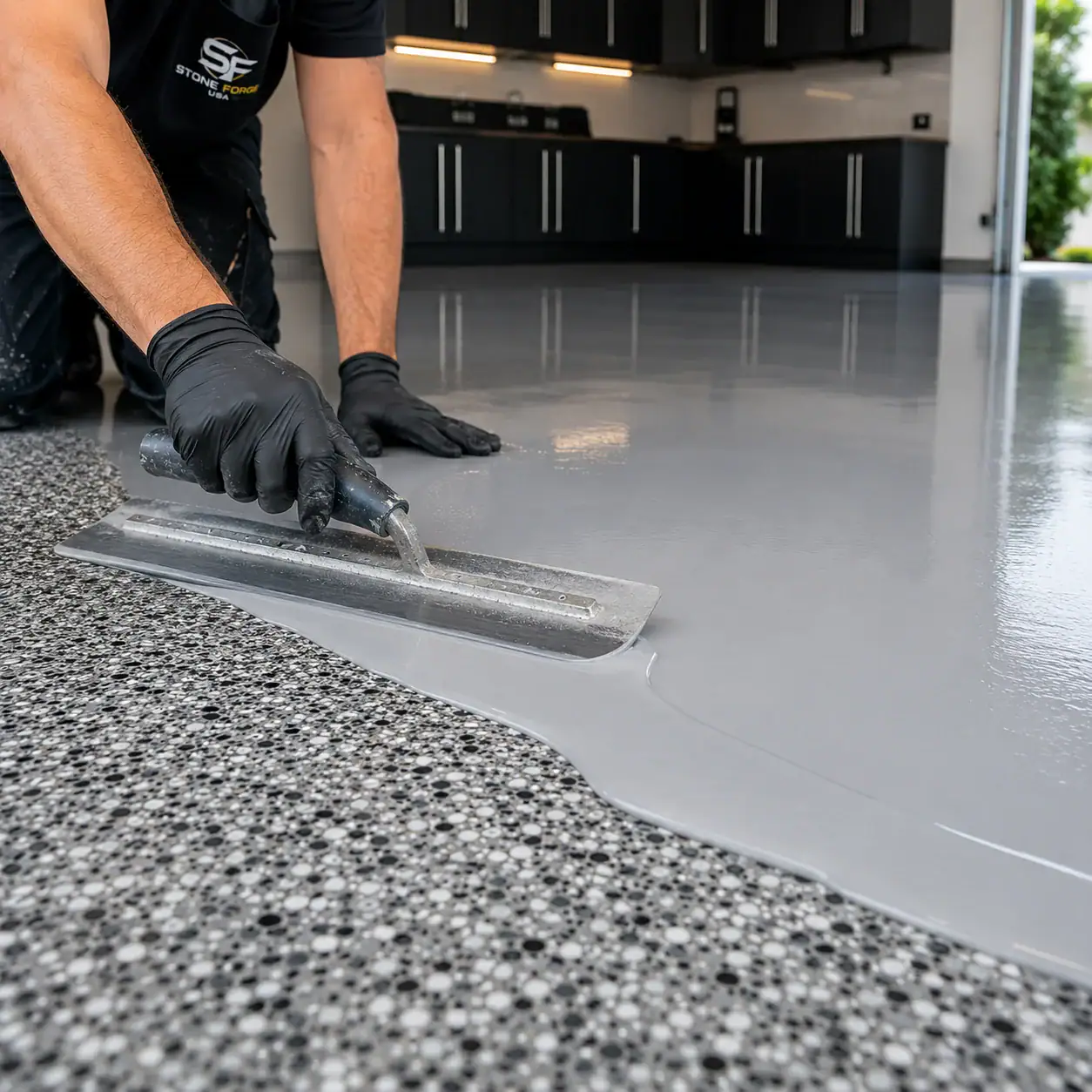
Professional concrete floor coating application by Stone Forge USA.

Cement Epoxy Systems for Damaged or High-Stress Garage Floors

Cement epoxy — sometimes called urethane cement or cementitious epoxy — is a hybrid system that combines the structural repair properties of masonry materials with the protective and chemical-resistant qualities of resin coatings. It’s designed for floors that have taken a beating: surfaces with significant cracking, contamination, or ongoing thermal cycling that causes the concrete to expand and contract more than standard epoxy can tolerate.

In a standard epoxy installation, the coating sits on top of the concrete and relies on adhesion to stay bonded. In a cement epoxy system, the material has more flexibility and can absorb minor movement in the substrate without cracking or delaminating. For older homes in Mount Dora or Eustis — where concrete slabs may have decades of history behind them — this matters. A slab that’s settled, shifted, or been repeatedly patched doesn’t disqualify you from getting a quality floor. It just means the system needs to be matched to the actual condition of the concrete, not the ideal version of it.

This is also the right conversation to have when a garage floor has been contaminated by oil, grease, or other chemicals over the years. Standard epoxy won’t bond reliably to contaminated concrete. Cement epoxy systems, combined with proper surface preparation and cleaning, can bridge that gap. We’ve worked on floors that looked beyond saving and came out looking better than the homeowner thought was possible. The key is honest assessment upfront — which is why we look at the actual slab before we quote anything.

Epoxy Basement Flooring in Florida: Managing Moisture Before It Manages You

Basement and below-grade spaces in Florida carry a reputation for being damp, dark, and difficult. That reputation is earned — but it’s not a permanent condition. The right epoxy basement flooring system, installed over a properly prepared and moisture-tested slab, can convert a problem space into one of the most functional areas in the house.

The critical step that separates a basement epoxy floor that lasts from one that fails within a year is moisture vapor emission testing. Concrete is porous, and in a humid environment like Lake County’s, moisture moves through the slab from below — even when the surface feels dry to the touch. If a coating is applied without testing for vapor emission, that moisture has nowhere to go except up, and it will eventually push the coating off the concrete from underneath. It’s one of the most common causes of epoxy failure in Florida, and it’s almost always preventable.

A proper installation starts with testing, then addresses any moisture mitigation needed before the coating system goes down. From there, the choice of system matters. We specify moisture-tolerant epoxy primers and topcoats that are formulated to handle the elevated humidity that’s simply part of life in Central Florida. The result is a sealed, non-porous surface that resists mold and mildew growth — a real benefit in a climate where untreated concrete can harbor both — and one that’s easy to clean, bright, and genuinely usable year-round.

For homeowners in Clermont’s newer developments who are finishing out a bonus room or utility space, or for older homes near the lake communities in Tavares and Eustis where moisture has always been a factor, epoxy basement flooring isn’t a luxury upgrade. It’s a practical solution to a real problem — and it pays for itself in usable square footage and reduced maintenance headaches.

How to Choose the Right Garage Flooring System for Your Lake County Home

The honest answer is that the right system depends on your specific slab, your space, and what you actually need the floor to do. A collector car garage in a newer Clermont subdivision has different requirements than a workshop floor in a 1970s Mount Dora home with decades of moisture history. Neither situation is a problem — they just call for different approaches.

What matters most, regardless of which system you choose, is that the concrete gets prepared properly, the materials are specified for Florida’s climate, and the person installing it understands what they’re working with before they start. A floor that’s installed correctly the first time will last fifteen to twenty years. One that isn’t will peel, yellow, or bubble — and you’ll be back to square one sooner than you’d like.

If you’re weighing your options and want a straight answer about what makes sense for your space, we’re happy to take a look and give you an honest assessment — no runaround, no pressure, and no surprises on the quote.

Summary:

If you’ve ever watched a neighbor’s epoxy floor bubble, yellow, or peel within a year or two, you already know that not all garage flooring is built the same. The system, the prep, and the materials make all the difference — especially in a climate like Lake County’s. This guide walks through seven flooring options that go well beyond the standard flake floor, from epoxy terrazzo and marble finishes to cement epoxy systems built for Florida’s moisture challenges. By the end, you’ll have a clear picture of what’s available, what holds up, and what questions to ask before committing to anything.

Table of Contents

Article details:

Share: